
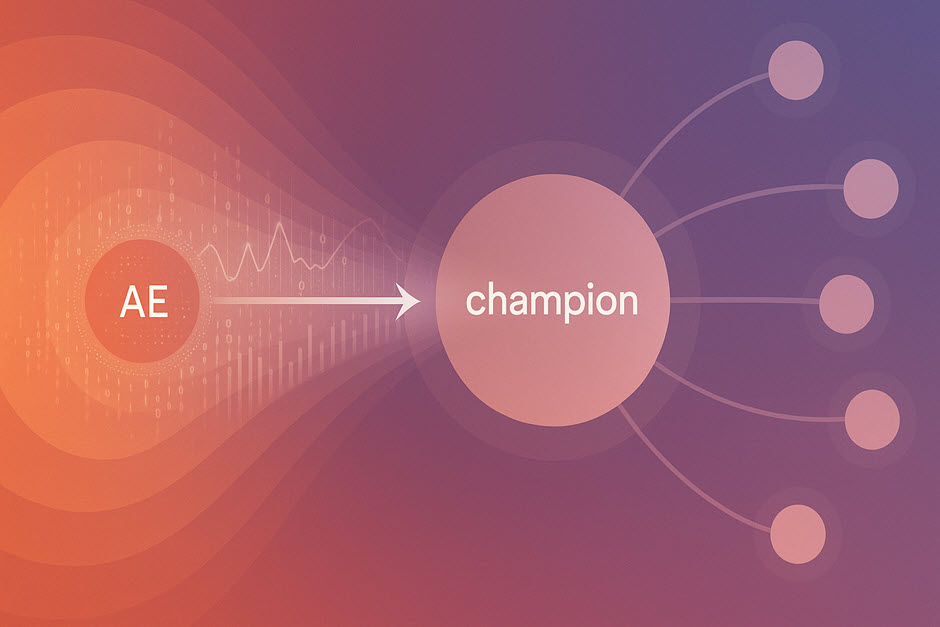
The Champion Problem Every AE Faces
The champion calls with good news and bad news. Good news: they secured a meeting with the CFO and the executive steering committee. Bad news: they want you there to present the business case. The problem is not the meeting itself. The problem is that the AE cannot be present for every internal conversation, every hallway discussion, and every follow-up question that determines whether this deal moves forward or stalls in committee review.
In complex B2B sales, the internal champion is the single most critical asset an account executive has. This individual is the advocate who supports the solution internally, navigates the political and logistical challenges of securing a new purchase, and sells when the rep cannot be in the room. Yet most champions are inadequately equipped for this role. They believe in the solution. They understand its capabilities. But when pressed by skeptical stakeholders or interrogated by a finance team armed with AI tools to validate vendor claims, they struggle to articulate quantified value with the confidence and precision required to win approval.
Research shows that the average B2B buying committee now includes six to 10 decision-makers, with enterprise deals involving up to 13 stakeholders. Each of these individuals has conducted their own AI-assisted research, formed their own opinions, and will scrutinize any investment proposal with tools that can instantly fact-check claims, compare industry benchmarks, and identify logical inconsistencies. The champion faces a room full of informed skeptics, and they need more than enthusiasm. They need evidence.
The AI-Enabled Stakeholder Challenge
The rise of AI-powered buyers has fundamentally changed what champions face internally. According to G2’s 2025 Buyer Behavior Report, 79% of buyers use AI search to conduct research, and this behavior extends to internal stakeholders evaluating proposals. When a champion brings a business case to the CFO, that executive may be simultaneously asking their AI copilot to validate assumptions, compare ROI claims against industry standards, and identify gaps in the financial model.
This dynamic creates a new requirement for champion enablement. The champion needs a business case that can withstand AI-assisted scrutiny. They need transparent assumptions that stakeholders can verify. They need documented sources that AI tools can validate. And they need the ability to adjust inputs in real-time when a finance leader asks, “What happens if we adjust this variable to match our actual operational metrics?”
The Traditional Enablement Failure
The traditional approach to champion enablement is to provide a slide deck summarizing product benefits, a few customer testimonials, and perhaps a simplified ROI estimate. This material is insufficient for three reasons.
First, it lacks the financial rigor that economic buyers demand. A CFO evaluating a significant investment does not make decisions based on feature lists or aspirational case studies. They require net present value, payback period, internal rate of return, and cost of delay, all calculated with transparent methodology they can validate. Without these metrics, the champion has no credible response when finance asks the inevitable question: “Why should we prioritize this investment over the dozen other projects competing for the same budget?”
Second, traditional enablement material is static and one-dimensional. It cannot adapt to the specific objections, questions, and scenarios that arise in dynamic internal discussions. When operations challenges a key assumption, or when sales leadership asks how the ROI changes if they only deploy to half the organization in year one, the champion has no way to model these variations. The conversation stalls, and the champion loses credibility.
Third, traditional materials are not designed for the AI verification era. When stakeholders can use AI tools to instantly validate vendor claims, a business case built on generic assumptions or unsubstantiated projections falls apart under scrutiny. The champion becomes the messenger of discredited information, which undermines not just the deal but their internal reputation.
How AI-Powered Platforms Enable Champions
AI-powered value selling platforms such as ValueNavigator™ fundamentally change the champion enablement equation. These platforms provide the champion with a transparent, buyer-editable business case that functions as a strategic tool rather than a static document. The champion is not handed a vendor pitch. They are given a collaborative framework they can own, adjust, and defend with confidence.
Consider the specific capabilities that matter for champion success. Platforms like ValueNavigator™ prepopulate all default values with researched industry data and include low, recommended, and high value ranges. When the champion presents to the CFO, they can say, “These assumptions are based on industry benchmarks from credible sources. But we can adjust any input to match our specific operational reality.” This transparency transforms the champion from a vendor representative into a strategic analyst conducting a thorough evaluation.
The framework is fully editable in real-time, which enables the champion to respond dynamically to stakeholder questions. When operations asks, “What if implementation takes six months instead of three?” the champion can adjust the timeline variable and instantly show how the ROI and payback period change. When finance asks, “What if we achieve only 70% of the projected efficiency gains?” the champion can model that conservative scenario on the spot. This responsiveness builds credibility because it demonstrates the champion has done rigorous analysis, not just accepted vendor promises.
Every assumption includes documented sources, which is critical for the AI verification era. When a skeptical stakeholder uses their AI copilot to fact-check a claim, the sources are already provided and verifiable. The champion is not caught off-guard. They are prepared with the transparency that modern buyers expect and that AI tools reward.
Real-World Champion Success Patterns
The practical impact of this enablement approach manifests differently across industries, but the pattern is consistent. In financial services, a champion advocating for a regulatory compliance platform can walk into a meeting with the Chief Risk Officer, Chief Compliance Officer, and CFO, open the business case on their laptop, and say, “Here is our analysis. We’ve quantified the cost of potential non-compliance at $420,000 annually based on historical penalty data, the efficiency gains from automated reporting at $180,000 annually, and the cost of current manual processes at $250,000 annually. Every assumption is documented and sourced. And we can adjust any variable right now if you believe our operational metrics differ from these benchmarks.”
In healthcare, a champion selling an AI-powered clinical documentation platform can present to a hospital executive team and demonstrate that the solution delivers $1.8 million in net present value over five years through reduced documentation burden on clinicians, improved coding accuracy, and decreased claim denials. When the CFO questions the assumption about clinician time savings, the champion can adjust the minutes-saved-per-encounter variable based on the hospital’s specific EHR workflow data, recalculate the ROI instantly, and show that even under conservative assumptions, the investment delivers a 12-month payback period.
In manufacturing, a champion advocating for predictive maintenance technology can quantify unplanned downtime costs at $52,000 monthly, maintenance labor efficiency improvements at $28,000 annually, and spare parts inventory optimization at $95,000 annually. When the VP of Operations challenges the downtime cost assumption, the champion can pull up the transparent calculation showing how that figure was derived from production capacity, average downtime hours, and revenue per production hour. The champion demonstrates command of the financial analysis, not dependence on vendor promises.
The Multithreading Strategy
Effective champion enablement also enables strategic multithreading across the buying committee. Gartner research identifies consensus creation as one of the most critical buying jobs in modern B2B transactions. The champion cannot create that consensus alone, especially when stakeholders have diverse priorities and conflicting agendas. But a transparent, customizable business case becomes the unifying artifact that speaks to each stakeholder’s specific concerns.
The champion can use the same underlying financial model but emphasize different outputs for different audiences. When presenting to the CFO, they lead with net present value, payback period, and internal rate of return. When presenting to sales leadership, they emphasize the revenue impact and competitive advantage. When presenting to operations, they highlight efficiency gains and productivity improvements. When presenting to IT, they focus on integration costs and technical implementation timelines. The business case adapts to each conversation while maintaining internal consistency, which builds trust and accelerates consensus.
This multithreading capability is particularly critical given that 62% of buyers now prefer to contact sellers later in their journey after conducting extensive AI-driven research. By the time the AE has their first conversation, multiple stakeholders have already formed preliminary opinions. The champion who can engage these stakeholders individually with tailored but consistent financial justification creates alignment before the formal evaluation even begins.
The Process: Collaborative Co-Creation
The most effective champion enablement is not a one-way handoff but a collaborative process. The AE and champion should build the business case together during the discovery and solution design phases. This co-creation serves multiple purposes.
First, it ensures the financial model reflects the buyer’s actual operational reality, not generic vendor assumptions. When the champion participates in setting the variables, adjusting the benchmarks, and validating the calculations, they develop deep ownership of the analysis. They are not presenting someone else’s work. They are presenting their own rigorous evaluation.
Second, the collaborative process gives the champion hands-on experience with the platform, which builds their confidence to use it independently in internal meetings. They learn how to adjust inputs, interpret outputs, and articulate the financial logic. This competence is what transforms a passive supporter into an active advocate.
Third, co-creation enables the AE to coach the champion on how to navigate specific stakeholders and anticipated objections. The AE can say, “When you meet with the CFO, lead with the payback period and net present value. When finance challenges the efficiency gain assumptions, here is how you adjust that variable and show the sensitivity analysis. When operations asks about implementation risk, here is the data on deployment timelines from similar organizations.” The champion walks into internal meetings prepared for the specific dynamics they will face.
The Competitive Advantage
The account executives who master champion enablement with AI-powered tools create a compounding competitive advantage. While competitors rely on traditional sales tactics and static presentations, the enabled champion is conducting internal selling with the same level of financial rigor that a CFO would expect from a strategic investment analysis. The competition is still pitching features. The champion is presenting verifiable ROI with transparent assumptions and documented sources.
In an environment where 86% of B2B deals stall, often due to inability to achieve internal consensus, the champion equipped with a robust, transparent, AI-ready business case becomes the catalyst that breaks through organizational inertia. They transform the evaluation from an abstract discussion about capabilities into a concrete analysis of financial impact. And they do it in a way that withstands the AI-assisted scrutiny that modern stakeholders bring to every investment decision.
The account executive cannot be in every meeting. But with the right enablement, the champion can sell with the same confidence, precision, and credibility as if the AE were standing beside them.
Key Takeaways
The Modern Champion Challenge:
- Average buying committees include 6-10 stakeholders (up to 13 for enterprise), each conducting AI-assisted research
- 79% of buyers use AI search, extending to internal stakeholders who fact-check business cases with AI copilots
- Traditional enablement (slide decks, testimonials, simplified ROI) lacks financial rigor for CFO-level scrutiny
- Champions face AI-empowered skeptics who can instantly validate claims and identify logical inconsistencies
AI-Powered Champion Enablement:
- ValueNavigator™ provides transparent, buyer-editable business cases that function as strategic tools, not static documents
- Prepopulated industry benchmarks with low, recommended, and high ranges enable confident, sourced assertions
- Real-time editability lets champions respond dynamically to stakeholder questions and model alternative scenarios
- Documented sources for every assumption enable champions to withstand AI verification and maintain credibility
Cross-Industry Success Patterns:
- Financial services: Quantify compliance costs, efficiency gains, and manual process expenses with verifiable sources
- Healthcare: Demonstrate NPV through clinician time savings, coding accuracy, and claim denial reduction
- Manufacturing: Model downtime costs, maintenance efficiency, and inventory optimization with transparent calculations
- Champions present their own rigorous analysis, not vendor promises, building internal credibility
Strategic Multithreading Advantage:
- Same underlying financial model adapts messaging for different stakeholders (CFO, Sales, Operations, IT)
- Gartner identifies consensus creation as critical buying job—transparent business cases create alignment
- 62% of buyers prefer later seller contact after AI research—champions engage stakeholders before formal evaluation
- Co-creation process gives champions ownership, confidence, and coaching for specific stakeholder dynamics
The Competitive Differentiator:
- While competitors pitch features, enabled champions present CFO-quality investment analysis with verifiable ROI
- 86% of deals stall from inability to achieve consensus—equipped champions break through organizational inertia
- Champion enablement with AI-ready tools creates compounding competitive advantage in complex sales
- AE cannot attend every meeting, but champion can sell with equivalent confidence, precision, and credibility

Resources
Connect with Darrin Fleming on LinkedIn
Connect with David Svigel on LinkedIn.
Join the Value Selling for B2B Marketing and Sales Leaders LinkedIn Group.
Visit the ROI Selling Resource Center.
Sources
Cited in order of appearance:
- Gartner (2024). “The New B2B Buying Journey” – https://www.gartner.com/en/sales/insights/b2b-buying-journey – Buying committee size (6-10 stakeholders, up to 13 for enterprise deals) and consensus creation as critical buying job
- G2 (2025). “2025 Buyer Behavior Report” – https://www.g2.com/reports/buyer-behavior-report-2025 – AI search usage (79%) and buyer contact preferences (62% prefer later seller contact)
- ValueNavigator™ (2025). Product capabilities and champion enablement features – https://app.valuenavigator.io/ – Platform features including transparent assumptions, real-time editability, documented sources
- Salesforce (2024). “State of Sales Report” – https://www.salesforce.com/resources/research-reports/state-of-sales/ – Deal stall statistics (86%)