
The Silent Competitor That Kills Most Deals
The competitive analysis is complete. The solution outperforms Competitor A on key features. It costs less than Competitor B. The technical evaluation validates superiority across multiple dimensions. And yet, six months after submitting the proposal, the deal remains in limbo. No competitor won. No alternative was selected. The buyer simply decided that the current state, while imperfect, is acceptable enough that making a change is not worth the effort, cost, and disruption.
This is the reality of the status quo competitor, and research shows it is far more formidable than any vendor alternative. According to industry data, 86% of B2B purchases stall during the buying process, and the primary reason is not competitive displacement but internal inability to justify that change is worth pursuing. The buyer organization acknowledges the problem. They understand the solution would provide value. But they cannot convince themselves or their stakeholders that the pain of staying with current state is greater than the pain of implementing change.
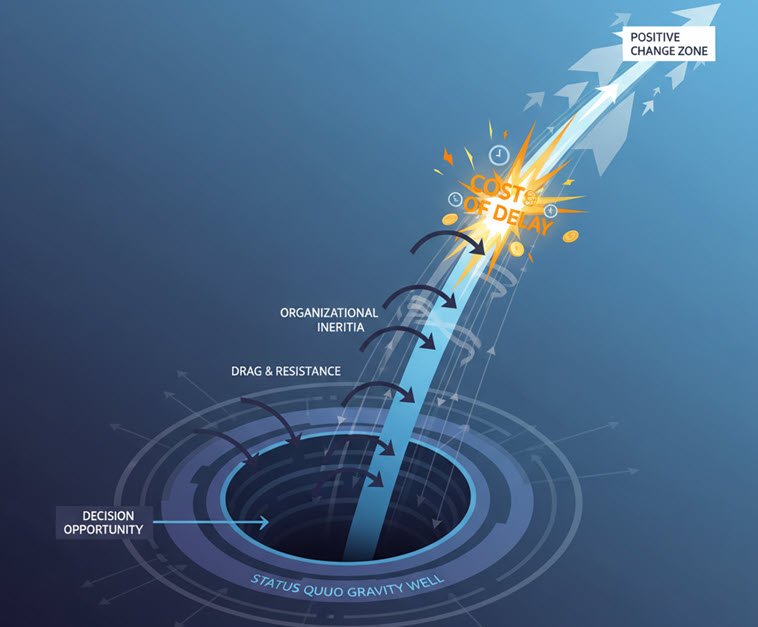
This status quo bias is deeply rooted in organizational psychology and risk management. Change requires energy, resources, and political capital. It introduces implementation risk, adoption uncertainty, and the possibility that projected benefits will not materialize. Maintaining current state requires none of these things. It is the default option that demands no justification, no budget request, no executive approval, and no organizational disruption. Unless the cost of inaction becomes visible and financially consequential, the gravitational pull toward doing nothing proves irresistible.
The traditional B2B sales approach focuses on building compelling visions of improved future states: faster workflows, better insights, enhanced capabilities, and competitive advantages. These aspirational benefits matter, but they are insufficient for overcoming status quo bias because they emphasize what could be gained without quantifying what is currently being lost. The buyer evaluates the proposal as an opportunity to capture value rather than an imperative to stop hemorrhaging value, which fundamentally changes the risk calculation.
Why Status Quo Defeats Feature Superiority
The conventional sales wisdom holds that demonstrating superior capabilities and competitive advantages should drive purchase decisions. But this wisdom fails to account for how buying committees actually evaluate change decisions. When stakeholders assess whether to maintain current state or implement new solutions, they apply asymmetric risk weighting where potential losses from change feel larger than potential gains, implementation challenges loom larger than operational benefits, and near-term disruption weighs heavier than long-term improvements.
Consider a manufacturing company evaluating production planning software. The current system is outdated, manual, and inefficient. The proposed solution offers advanced analytics, automated scheduling, and real-time visibility. The features are superior. The technology is modern. But the buying committee focuses on implementation risk: How long will deployment take? What if adoption is slower than projected? What if integration with existing systems proves complex? What if the efficiency gains don’t materialize as promised? These concerns, while legitimate, overshadow the substantial ongoing costs of maintaining inefficient current systems because those costs have become normalized as acceptable background friction.
According to G2’s 2025 Buyer Behavior Report, 79% of buyers use AI search to conduct research, and AI tools often reinforce status quo bias by surfacing implementation challenges, failed deployment stories, and vendor switching costs without quantifying the ongoing cost of current inefficiency. When a buying committee member asks their AI copilot “What are the risks of implementing new production planning software?” the AI provides a comprehensive list of potential issues without balancing against the quantified cost of continuing with current inefficient systems. This AI-enabled risk analysis strengthens the case for inaction unless sellers provide equally rigorous quantification of inaction costs.
The Cost of Delay Framework
The strategic response to status quo competition is not better feature demonstrations or more compelling vision statements but rigorous quantification of what the organization forfeits every month they delay implementation. This cost of delay framework transforms the decision from “Should we invest in improvement?” to “Can we afford to continue losing value while we deliberate?”
AI-powered value selling platforms such as ValueNavigator™ enable precise calculation of monthly costs associated with maintaining current state. The methodology involves identifying operational inefficiencies that current solutions create, quantifying the financial impact of those inefficiencies using buyer-specific metrics, calculating the monthly cost by dividing annual impact by twelve, and presenting cost of delay as a recurring loss that accumulates during evaluation.
Consider a practical healthcare example. A hospital system evaluates clinical documentation software to reduce physician administrative burden. The current state involves physicians spending an average of 18 hours weekly on documentation, which at an average physician compensation of $185 per hour represents $173,160 annually per physician. For a hospital system with 120 physicians, the annual cost of current documentation inefficiency is $20.8 million. The monthly cost of delay is therefore $1.73 million.
When presented this way, the buying committee’s evaluation shifts dramatically. They are no longer deciding whether to invest $2.4 million over three years in new software. They are deciding whether to continue forfeiting $1.73 million monthly while they evaluate alternatives, negotiate contracts, and wait for the perfect implementation timing. The question becomes not “Is this investment justified?” but rather “How quickly can we stop the bleeding?”
Cross-Industry Cost of Delay Patterns
The effectiveness of cost of delay quantification varies by industry based on how visible and measurable current inefficiencies are. However, consistent patterns emerge across verticals when the financial impact of inaction is made explicit rather than remaining implicit.
In manufacturing, where downtime, quality issues, and inefficiencies directly translate to lost production revenue, cost of delay calculations are particularly powerful. A manufacturing operation evaluating predictive maintenance technology can quantify: unplanned downtime costing $8,200 per hour based on production capacity and revenue per unit, occurring an average of 47 hours quarterly, representing $154,700 quarterly cost or $51,500 monthly cost of delay. Quality defects averaging 3.2% of production requiring rework costing $28,000 monthly. Reactive maintenance requiring 40% more labor than predictive approaches costing $19,000 monthly in excess maintenance expense.
The total monthly cost of delay of $98,500 transforms the evaluation. The buying committee is not assessing whether predictive maintenance technology delivers adequate ROI. They are recognizing that every month they delay implementation costs $98,500 in preventable losses. Manufacturing organizations using cost of delay frameworks report 50-60% reduction in evaluation cycles because the urgency becomes financially undeniable.
In financial services, where operational inefficiencies impact transaction processing, compliance costs, and fraud exposure, cost of delay frameworks quantify: manual transaction reconciliation errors costing $180,000 annually in correction labor and customer remediation, compliance manual reporting consuming 320 hours monthly at $85 per hour loaded cost representing $326,400 annual cost, fraud detection lag averaging 8.5 days resulting in $240,000 annual fraud losses that could be prevented with real-time systems.
The monthly cost of delay of $62,200 creates urgency that feature comparisons cannot generate. Financial services organizations report that cost of delay presentations reduce status quo persistence by 40-50% because the buyer cannot justify to their board why they are continuing to lose $62,200 monthly while they evaluate whether to proceed.
In SaaS companies evaluating sales enablement platforms, the cost of delay calculation includes: sales rep productivity inefficiency from fragmented content and tools costing 6.5 hours per rep weekly, which at 45 reps and $140,000 average compensation represents $1.02 million annual productivity loss. Sales cycle length 22% longer than industry benchmark due to content accessibility issues resulting in $840,000 annual opportunity cost based on quota attainment analysis. Win rate 8 percentage points below top quartile peer companies representing $1.4 million annual revenue loss.
The monthly cost of delay of $271,000 makes continued evaluation while forfeiting this value economically irrational. SaaS organizations using cost of delay frameworks report 45-55% faster decision cycles because the financial logic of acting quickly becomes compelling.
The Psychological Impact of Loss Framing
Beyond the pure financial calculation, cost of delay frameworks leverage loss aversion psychology that behavioral economics research has consistently validated. Human decision-makers weight losses more heavily than equivalent gains, which means framing current inefficiency as ongoing loss creates stronger motivation than framing new solutions as future gains.
When a sales presentation emphasizes “This solution will save you $98,500 monthly through predictive maintenance and quality improvements,” the buyer evaluates it as a potential gain with associated risks and implementation costs. When the presentation instead emphasizes “Your current system is costing you $98,500 monthly through unplanned downtime, quality defects, and reactive maintenance. This solution stops those losses,” the buyer evaluates it as loss mitigation, which triggers stronger urgency because the loss is already occurring regardless of whether they take action.
The framing shifts from opportunity (we could gain value) to imperative (we must stop losing value). This psychological reframe, when combined with rigorous quantification, overcomes status quo bias by making the cost of inaction emotionally and financially unacceptable.
Additionally, cost of delay creates time pressure that aspirational benefits do not. When the sales narrative is “Implement this solution and you’ll achieve 22% efficiency improvements,” the buyer can defer indefinitely because the improvement is always available in the future. When the narrative is “You’re losing $98,500 every month you delay. Each quarter of evaluation costs you $295,500 in preventable losses,” deferral has explicit cost, which changes the urgency calculation.
AI Verification of Cost of Delay Claims
The rise of AI-enabled buyers creates both a challenge and an opportunity for cost of delay frameworks. The challenge is that buyers can use AI tools to validate cost assumptions, which means inflated or unsubstantiated loss calculations are quickly exposed. The opportunity is that well-sourced, transparent cost of delay calculations are reinforced by AI verification, which builds buyer confidence in the urgency narrative.
When a buyer uses their AI copilot to validate a cost of delay claim such as “Your organization is forfeiting $1.73 million monthly in physician productivity costs due to documentation inefficiency,” the AI tool can verify whether physician time allocation data aligns with healthcare industry research, compensation assumptions match regional and specialty averages, and calculation methodology follows standard labor cost analysis approaches. If the cost of delay framework uses credible sources and transparent methodology, the AI verification strengthens the urgency case.
Platforms like ValueNavigator™ enable this AI verification by documenting sources for every assumption: physician documentation time from time-motion studies published in medical journals, physician compensation from MGMA (Medical Group Management Association) benchmarks specific to specialties and regions, and opportunity cost calculations using standard economic methodologies. When the buyer’s AI tool analyzes these inputs, it confirms the cost of delay calculation is credible, which removes skepticism about whether the urgency is manufactured or genuine.
By contrast, cost of delay claims made without transparent sourcing or rigorous methodology fail AI verification. The buyer’s AI tool flags assumptions that cannot be validated, identifies calculation errors, and generates skepticism that undermines the entire urgency narrative. In the AI era, cost of delay frameworks must be built with the same professional rigor as financial projections because buyers and their AI tools will scrutinize them accordingly.
Integrating Cost of Delay Into the Business Case
Effective use of cost of delay requires integration into the complete business case rather than presenting it as an isolated urgency tactic. The most compelling approach combines forward-looking value realization (what implementing the solution will deliver) with backward-looking cost quantification (what maintaining current state is costing).
The integrated narrative structure follows this pattern: quantify current state cost of delay as the baseline loss the organization is sustaining, present the solution’s value delivery as both stopping the loss and creating new value, calculate net impact as cost of delay elimination plus additional value creation, and determine payback period showing how quickly the investment stops the bleeding and begins generating positive returns.
Using the manufacturing predictive maintenance example, the integrated business case presents: current monthly cost of delay of $98,500 ($1.18 million annually) represents the baseline loss, implementation of predictive maintenance stops 85% of this loss ($1.0 million annually) and creates additional $420,000 in value through optimized maintenance scheduling and extended equipment life, total annual value is $1.42 million (cost of delay eliminated plus new value), and against $180,000 implementation cost plus $96,000 annual subscription, payback is achieved in 2.3 months.
This integrated approach makes the cost of delay visible without making it the entire story. The buyer sees both the urgency of stopping current losses and the opportunity of capturing new value, which creates motivation that either element alone would not achieve.
Overcoming “We’re Managing Fine” Objections
One of the most common objections to cost of delay frameworks is the buyer’s assertion that “We’re managing fine with current systems. The costs you’re describing are not as severe as you claim.” This objection is predictable because organizations adapt to inefficiency over time, and what seems costly to external analysis feels manageable to internal stakeholders who have normalized the problems.
The response to this objection requires shifting from abstract cost claims to specific operational validation. Instead of asserting “Your documentation inefficiency costs $1.73 million monthly,” the conversation becomes: “Let’s validate this together. Your physicians average how many hours weekly on documentation? What is your average physician compensation? Let’s calculate the cost using your actual data rather than our assumptions.”
This collaborative validation approach using platforms like ValueNavigator™ enables real-time cost calculation based on the buyer’s specific operational metrics. When the buyer provides their actual data—physicians spend 19 hours weekly on documentation, average compensation is $192,000, system has 135 physicians—the cost of delay calculation updates immediately to reflect their reality: $1.97 million monthly, which is even higher than the initial estimate.
This collaborative approach accomplishes two objectives. It demonstrates that the seller is not inflating numbers but using rigorous methodology that can be validated with buyer data. And it creates buyer ownership of the cost calculation because they provided the inputs, which makes the urgency harder to dismiss as vendor fearmongering.
The Champion’s Role in Communicating Urgency
Internal champions play a critical role in translating cost of delay frameworks into organizational urgency, but they require specific enablement to communicate financial loss effectively. The champion may understand operationally that current systems are inefficient, but translating that understanding into compelling financial urgency for executive stakeholders requires tools and coaching.
Effective champion enablement for cost of delay communication includes: providing the champion with the complete cost of delay calculation showing methodology and sources, equipping them with talking points for anticipated objections (“We’re managing fine,” “The timing isn’t right,” “Let’s wait until next fiscal year”), preparing scenarios showing cumulative loss over evaluation periods (three-month delay costs X, six-month delay costs 2X, etc.), and coaching them to frame cost of delay as fiduciary responsibility rather than vendor pressure (“As stewards of organizational resources, we have a responsibility to address preventable losses that are costing us $1.73 million monthly”).
The champion can then present to executive stakeholders with confidence: “I’m bringing this investment recommendation forward not just because the new system offers better capabilities but because our current system is costing us $1.73 million monthly in preventable physician productivity losses. Every month we delay this decision, we forfeit that value. The implementation will pay back in 4.2 months, which means if we delay six months to evaluate, we’ve lost $10.4 million in preventable costs plus pushed our payback back half a year. The question is not whether we can afford to invest $2.4 million. It’s whether we can afford to keep losing $1.73 million monthly while we deliberate.”
This executive-level framing positions the champion as a responsible steward addressing preventable losses rather than an enthusiastic advocate pushing for new technology, which resonates more effectively with risk-averse executive audiences.
Building Organizational Discipline Around Status Quo Competition
Consistently defeating status quo competition requires organizational capabilities that most B2B sales teams have not developed systematically. This capability building involves training sellers to recognize status quo as the primary competitor in most deals, teaching cost of delay quantification methodology and how to present it compellingly, equipping them with tools like ValueNavigator™ that enable rigorous, buyer-specific cost calculations, and measuring deals lost to status quo separately from deals lost to competitors to understand true competitive dynamics.
Sales leaders should establish explicit milestones in the sales process for cost of delay quantification, typically during discovery when current state pain is being documented. The cost of delay framework should be introduced early and refined throughout the sales cycle as the buyer’s understanding of their inefficiency costs deepens.
Organizations that build systematic status quo competition capability report measurable improvements: 40-50% reduction in deals lost to “do nothing” decisions, 30-40% shorter sales cycles because urgency accelerates decision-making, 20-30% higher win rates overall because status quo defeats are converted to closed deals, and 25-35% improvement in forecast accuracy because deals with quantified cost of delay progress more predictably than deals relying on aspirational benefits alone.
The Strategic Imperative
Status quo is not a passive absence of decision. It is an active choice that buying committees make when they conclude that the certain costs and risks of change exceed the perceived costs of maintaining current state. In an era where 86% of deals stall, where AI tools enable buyers to thoroughly research implementation challenges, and where organizational change fatigue makes doing nothing feel safer than pursuing improvement, the vendors who systematically quantify the cost of inaction create urgency that feature superiority and relationship leverage cannot generate.
The path forward requires recognizing that every B2B deal has three competitors: your solution, alternative vendors, and status quo, with status quo being the most formidable. It requires investment in platforms like ValueNavigator™ that enable rigorous, transparent cost of delay calculations that withstand AI-assisted buyer scrutiny. It requires training sales teams to lead with loss framing that makes invisible costs visible and monthly losses financially intolerable. And it requires process discipline that treats cost of delay quantification as a mandatory element of every strategic sales opportunity.
In a marketplace where the gravitational pull toward inaction is stronger than ever, where buying committees are larger and more risk-averse, and where AI tools surface implementation challenges without quantifying inaction costs, the ability to make the financial cost of status quo visible and emotionally compelling is the competitive capability that determines which vendors consistently close deals and which vendors watch opportunities vanish into perpetual evaluation.
Key Takeaways
The Status Quo Competitor Reality:
- 86% of B2B purchases stall during buying process, primary reason not competitive displacement but internal inability to justify change is worth pursuing
- Buyer acknowledges problem, understands solution would provide value, cannot convince themselves/stakeholders pain of staying with current state greater than pain of implementing change
- Status quo bias deeply rooted: Change requires energy, resources, political capital; introduces implementation risk, adoption uncertainty, possibility benefits won’t materialize
- Maintaining current state requires none of these—default option demanding no justification, no budget request, no executive approval, no organizational disruption
- Unless cost of inaction becomes visible and financially consequential, gravitational pull toward doing nothing proves irresistible
- Traditional approach emphasizes improved future states (faster workflows, better insights, enhanced capabilities, competitive advantages)—insufficient for overcoming status quo bias
- Emphasizes what could be gained without quantifying what currently being lost—buyer evaluates as opportunity to capture value not imperative to stop hemorrhaging value
Why Status Quo Defeats Feature Superiority:
- Conventional wisdom: demonstrating superior capabilities and competitive advantages should drive purchase decisions
- Fails to account for how buying committees actually evaluate change decisions
- Asymmetric risk weighting: Potential losses from change feel larger than potential gains, implementation challenges loom larger than operational benefits, near-term disruption weighs heavier than long-term improvements
- Manufacturing example: current system outdated/manual/inefficient, proposed solution offers advanced analytics/automated scheduling/real-time visibility, features superior, technology modern
- But committee focuses implementation risk: deployment length, adoption speed, integration complexity, whether efficiency gains materialize
- These concerns overshadow substantial ongoing costs of maintaining inefficient systems because costs normalized as acceptable background friction
- 79% of buyers use AI search: AI tools reinforce status quo bias by surfacing implementation challenges, failed deployment stories, vendor switching costs WITHOUT quantifying ongoing cost of current inefficiency
- Committee member asks AI “What are risks of implementing new production planning software?” AI provides comprehensive risk list without balancing against quantified cost of continuing with current inefficient systems
- AI-enabled risk analysis strengthens case for inaction unless sellers provide equally rigorous quantification of inaction costs
Cost of Delay Framework:
- Strategic response not better feature demonstrations or vision statements but rigorous quantification of what organization forfeits every month they delay
- Transforms decision from “Should we invest in improvement?” to “Can we afford to continue losing value while deliberating?”
- ValueNavigator™ methodology: Identify operational inefficiencies current solutions create, quantify financial impact using buyer-specific metrics, calculate monthly cost dividing annual impact by twelve, present cost of delay as recurring loss accumulating during evaluation
- Healthcare example: Hospital system evaluates clinical documentation software
- Current state: physicians average 18 hours weekly on documentation, $185/hour average compensation = $173,160 annually per physician
- 120 physicians = $20.8M annual cost of current documentation inefficiency
- Monthly cost of delay: $1.73M
- Evaluation shifts: not deciding whether to invest $2.4M over 3 years in new software but whether to continue forfeiting $1.73M monthly while evaluating alternatives, negotiating contracts, waiting for perfect timing
- Question becomes not “Is investment justified?” but “How quickly can we stop the bleeding?”
Cross-Industry Cost of Delay Patterns:
- Manufacturing (predictive maintenance): Unplanned downtime $8,200/hour, 47 hours quarterly = $154,700 quarterly ($51,500 monthly), quality defects 3.2% requiring rework ($28,000 monthly), reactive maintenance 40% more labor ($19,000 monthly excess)
- Total monthly cost of delay: $98,500—not assessing adequate ROI but recognizing every delay month costs $98,500 preventable losses
- Manufacturing organizations report 50-60% reduction in evaluation cycles—urgency financially undeniable
- Financial services (automation platform): Manual reconciliation errors ($180K annual correction/remediation), compliance manual reporting 320 hours monthly at $85/hour ($326,400 annual), fraud detection lag 8.5 days ($240K annual preventable fraud)
- Monthly cost of delay: $62,200—cannot justify to board why continuing to lose $62,200 monthly while evaluating whether to proceed
- Financial services report 40-50% reduction in status quo persistence
- SaaS companies (sales enablement): Sales rep productivity inefficiency 6.5 hours/rep weekly, 45 reps at $140K average = $1.02M annual productivity loss, sales cycle 22% longer than benchmark ($840K annual opportunity cost), win rate 8 points below top quartile ($1.4M annual revenue loss)
- Monthly cost of delay: $271,000—continued evaluation while forfeiting this value economically irrational
- SaaS organizations report 45-55% faster decision cycles
Psychological Impact of Loss Framing:
- Cost of delay leverages loss aversion psychology validated by behavioral economics research
- Human decision-makers weight losses more heavily than equivalent gains
- Framing current inefficiency as ongoing loss creates stronger motivation than framing new solutions as future gains
- Gain framing: “Solution will save you $98,500 monthly through predictive maintenance”—buyer evaluates as potential gain with associated risks and implementation costs
- Loss framing: “Current system costing you $98,500 monthly through unplanned downtime, quality defects, reactive maintenance. Solution stops those losses”—buyer evaluates as loss mitigation triggering stronger urgency because loss already occurring
- Shifts from opportunity (we could gain value) to imperative (we must stop losing value)
- Time pressure: Aspirational “Implement and achieve 22% efficiency improvements” allows indefinite deferral (improvement always available future)
- Cost of delay “Losing $98,500 every month you delay. Each quarter costs $295,500 preventable losses” makes deferral have explicit cost
AI Verification of Cost of Delay:
- Challenge: buyers use AI to validate cost assumptions—inflated or unsubstantiated loss calculations quickly exposed
- Opportunity: well-sourced transparent cost of delay calculations reinforced by AI verification building buyer confidence
- Buyer asks AI copilot to validate “$1.73M monthly physician productivity costs due to documentation inefficiency”
- AI verifies: physician time allocation aligns with healthcare industry research, compensation matches regional and specialty averages, calculation methodology follows standard labor cost analysis
- If credible sources and transparent methodology, AI verification strengthens urgency case
- ValueNavigator™ enables AI verification: Documents sources for every assumption—physician documentation time from time-motion studies in medical journals, compensation from MGMA benchmarks (specialty/region-specific), opportunity cost using standard economic methodologies
- Buyer’s AI analyzes inputs, confirms cost of delay calculation credible, removes skepticism about manufactured vs genuine urgency
- By contrast: unsourced/unrigorous claims fail AI verification—AI flags unvalidatable assumptions, identifies calculation errors, generates skepticism undermining entire urgency narrative
- In AI era, cost of delay frameworks must have professional rigor matching financial projections—buyers and AI tools scrutinize accordingly
Integrated Business Case Approach:
- Effective cost of delay requires integration into complete business case not isolated urgency tactic
- Narrative structure: Quantify current state cost of delay as baseline loss organization sustaining, present solution value as both stopping loss and creating new value, calculate net impact as cost of delay elimination plus additional value creation, determine payback showing how quickly investment stops bleeding and generates positive returns
- Manufacturing predictive maintenance integrated example:
- Current monthly cost of delay $98,500 ($1.18M annually) = baseline loss
- Implementation stops 85% of loss ($1.0M annually) + creates additional $420K value (optimized scheduling, extended equipment life)
- Total annual value $1.42M (eliminated cost of delay + new value)
- Against $180K implementation + $96K annual subscription, payback in 2.3 months
- Makes cost of delay visible without making it entire story—buyer sees urgency of stopping current losses AND opportunity of capturing new value
Overcoming “We’re Managing Fine” Objections:
- Common objection: “We’re managing fine with current systems. Costs you’re describing not as severe as claimed.”
- Predictable because organizations adapt to inefficiency over time—what seems costly externally feels manageable internally (normalized problems)
- Response requires shifting from abstract cost claims to specific operational validation
- Not asserting “Your documentation inefficiency costs $1.73M monthly” but “Let’s validate together. Your physicians average how many hours weekly on documentation? What’s average compensation? Let’s calculate using YOUR actual data not our assumptions.”
- Collaborative validation using ValueNavigator™: Real-time cost calculation based on buyer’s specific operational metrics
- Buyer provides actual data: physicians 19 hours weekly documentation, $192K average compensation, 135 physicians
- Cost of delay updates immediately: $1.97M monthly (even higher than initial estimate)
- Accomplishes: demonstrates seller not inflating numbers but using rigorous methodology validatable with buyer data, creates buyer ownership of cost calculation (they provided inputs) making urgency harder to dismiss as vendor fearmongering
Champion Enablement for Urgency Communication:
- Champions understand operationally current systems inefficient but translating to compelling financial urgency for executives requires tools and coaching
- Effective enablement includes: Complete cost of delay calculation with methodology and sources, talking points for anticipated objections (“We’re managing fine,” “Timing isn’t right,” “Wait until next fiscal year”), scenarios showing cumulative loss over evaluation periods (3-month delay costs X, 6-month costs 2X), coaching to frame as fiduciary responsibility not vendor pressure (“As stewards of resources, responsibility to address preventable losses costing $1.73M monthly”)
- Champion to executives: “Bringing recommendation not just because new system offers better capabilities but because current system costing $1.73M monthly preventable physician productivity losses. Every month delay, forfeit that value. Implementation pays back 4.2 months—if delay 6 months to evaluate, lost $10.4M preventable costs plus pushed payback back half year. Question not whether can afford to invest $2.4M but whether can afford to keep losing $1.73M monthly while deliberating.”
- Positions champion as responsible steward addressing preventable losses not enthusiastic advocate pushing new technology—resonates more effectively with risk-averse executive audiences
Organizational Capability Building:
- Training: Recognize status quo as primary competitor most deals, teach cost of delay quantification methodology and compelling presentation, equip with tools (ValueNavigator™) enabling rigorous buyer-specific calculations, measure deals lost to status quo separately from competitor losses to understand true dynamics
- Process discipline: Explicit sales process milestones for cost of delay quantification (typically during discovery when documenting current state pain), introduce framework early and refine throughout cycle as buyer’s understanding deepens
- Measurable improvements from systematic capability:
- 40-50% reduction in deals lost to “do nothing” decisions
- 30-40% shorter sales cycles (urgency accelerates decision-making)
- 20-30% higher overall win rates (status quo defeats converted to closed deals)
- 25-35% improvement in forecast accuracy (deals with quantified cost of delay progress more predictably than aspirational benefits alone)
Strategic Imperative:
- Status quo not passive absence of decision—active choice buying committees make when concluding certain costs/risks of change exceed perceived costs of maintaining current state
- Era where 86% of deals stall, AI tools enable thorough implementation challenge research, organizational change fatigue makes doing nothing feel safer than pursuing improvement
- Vendors systematically quantifying cost of inaction create urgency feature superiority and relationship leverage cannot generate
- Path forward: recognize every B2B deal has three competitors (your solution, alternative vendors, status quo—with status quo most formidable)
- Investment in platforms (ValueNavigator™) enabling rigorous transparent cost of delay calculations withstanding AI-assisted buyer scrutiny
- Training sales teams to lead with loss framing making invisible costs visible and monthly losses financially intolerable
- Process discipline treating cost of delay quantification as mandatory element of every strategic opportunity
- Marketplace where gravitational pull toward inaction stronger than ever, buying committees larger and more risk-averse, AI tools surface implementation challenges without quantifying inaction costs
- Ability to make financial cost of status quo visible and emotionally compelling is competitive capability determining which vendors consistently close deals versus watch opportunities vanish into perpetual evaluation

Resources
Connect with Darrin Fleming on LinkedIn
Connect with David Svigel on LinkedIn.
Join the Value Selling for B2B Marketing and Sales Leaders LinkedIn Group.
Visit the ROI Selling Resource Center.
Sources
Cited in order of appearance:
- Salesforce (2024). “State of Sales Report” – https://www.salesforce.com/resources/research-reports/state-of-sales/ – Deal stall statistics (86%)
- G2 (2025). “2025 Buyer Behavior Report” – https://www.g2.com/reports/buyer-behavior-report-2025 – AI search usage (79%) and AI-enabled risk analysis reinforcing status quo bias
- ValueNavigator™ (2025). Cost of delay calculation and status quo competition capabilities – https://app.valuenavigator.io/ – Platform features for quantifying monthly costs of maintaining current state, transparent sourcing, buyer-specific calculations
- Behavioral Economics Research. Loss aversion and framing effects – Multiple academic sources on loss aversion psychology (Kahneman & Tversky foundational research)